|
|||
Wheels Comparison Test
Source:
Wheels, Jan 1973.
A
FOUR AND TWO SIXES.
Click on the thumbnails below to view the enlarged image
|
|
|
Cortina
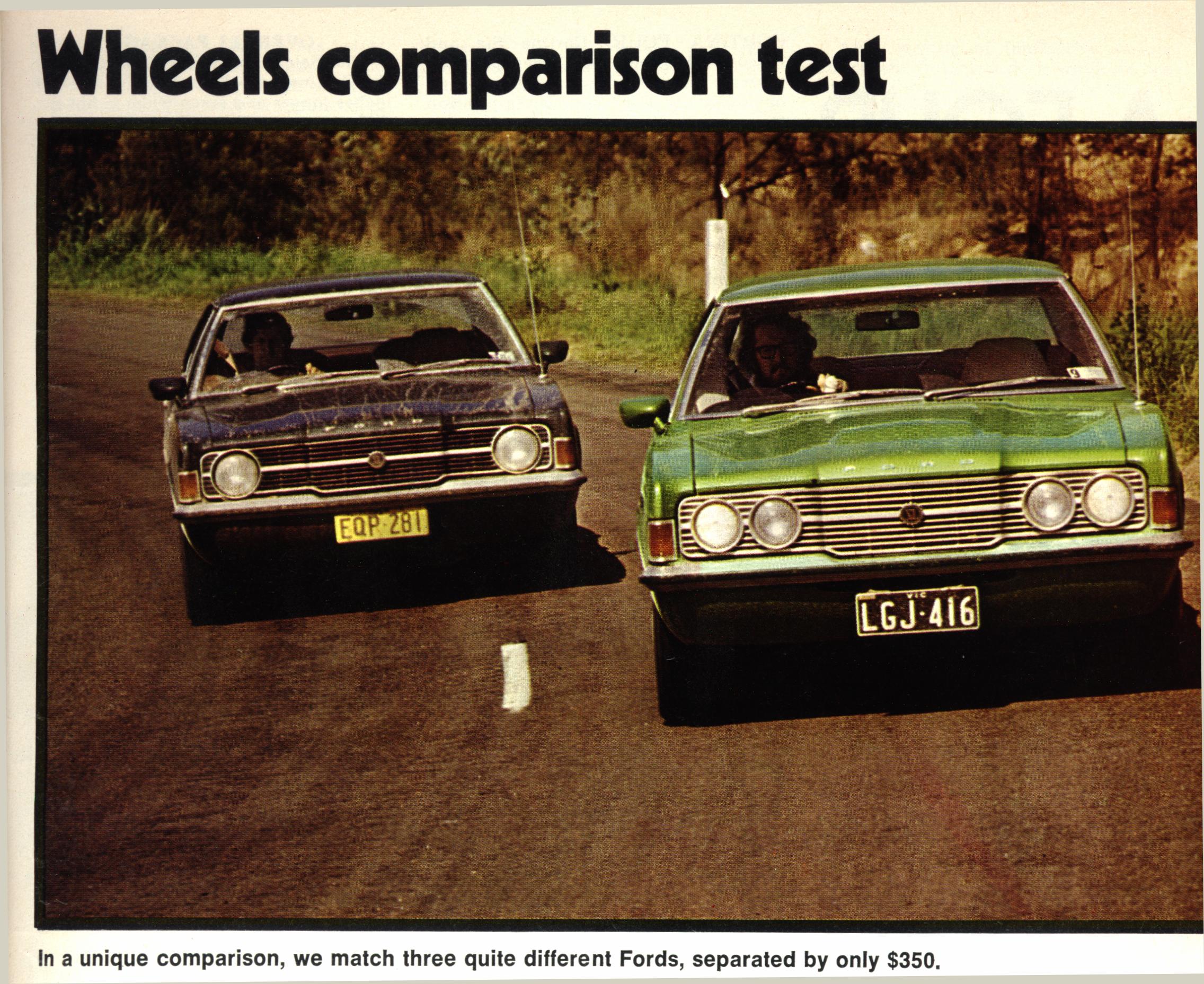
Four, Cortina Six and Falcon – between
them, they cover 80 percent of the popular classes and obviously put Ford in
a strong position to make good its bid for the Number One spot on the market.
But the respective Cortina and Falcon models don’t always compete only
against rival cars of different makes.
Because of the inevitable overlapping among them in some areas such as
price and performance, the Fords frequently vie with each other for the buyers
dollar.
So, how much similarity – or difference – is there between them?
Depending on what you’re looking for, there’s more in it than you might
think – or less than you may expect. These
aspects were brought home to us during a week spent with a Cortina Four, Cortina
Six and Falcon Six.
The Four came with the overhead cam two-litre engine which easily, and
understandably, out-sells the standard 1600 mill.
It’s still too early to pick a most popular engine/transmission combination
from the half-dozen alternatives available for the Cortina Six.
Our example had the 250 cubic-incher mated to the four-speed manual gearbox.
In the interests of direct comparisons, a 250 four-speed plant was also
fitted to our third car, a Falcon hardtop.
PRICES
The basic L model Cortina Four costs $2590 with the 1600 engine, while
the optional 2000 ohc engine adds $85.
Though Ford puts it otherwise, we usually think of the $2675 2000L as
the standard model, with the 1600 being a delete-option version for those who
must save the $85. The smaller
engine sacrifices quite a lot of performance, yet gains little, if any, fuel
economy. So for performance per dollar, the 2000 is an appreciably better
buy.
There is then a $140 step up to the $2815 2000XL version which is adequately,
but by no means lavishly, “deluxised”.
That’s not the end of it, of course you could spend hundreds more on
sporty and/or fancy goodies from the wide range of options.
But even at its base price, the 2000XL is only $80 under the Cortina Six
L model with 200 cu in. engine and three-speed gearbox for $2895.
Here again there’s a $140 increment to the mechanically-identical XL
edition which at $3035, is $15 dearer than the stock Falcon 500 sedan offering
the same engine and gearbox in a more spartan but bigger package.
Next along is the Falcon 500 hardtop.
This costs $175 more than the sedan, but the $3195 price includes carpets
and reclining buckets amongst the original equipment whereas they’re a $121
option on the sedan.
We thought that $155 was pretty steep for the four-speed gearbox on the Cortina Six. With the Falcon you get the same box for the same money, but must add a further $33 for the mandatory console that comes with it.
OVERALL PACKAGE
The Falcon body is a lot bigger than the Cortina’s on the outside – about
19 inches longer and seven wider – but the differences aren’t really great on
the inside.
The larger car has thicker doors and more overhang.
The extra 9.5 inches of wheelbase is taken mostly by the pedals being
farther back from the front axle line, while the rear seat is farther forward
of the back axle and the front seat is thicker.
So, for effective interior space, the larger car scores only with a few
more inches rear seat leg room and hip/shoulder width.
For driving, the Cortina holds the advantages because its more compact
dimensions make it easier to place, manoeuvre and park.
It also has better all-round vision.
From inside, the Falcon feels to be a very large car.
This impression is even more pronounced in the hardtop due to its shorter
windscreen and abominably restricted ¾-rear and rear vision.
On a 6 am start one morning, we found the hardtop’s rear window was fogged
but didn’t wipe it as we wanted to see how long it would take to clear itself.
Despite driving with the windows down, the rear pane was still fogged
when we arrived at Castlereagh dragstrip, 50 miles and over an hour later.
In the Cortina, vision would be further improved if the front seats were
mounted up to an inch higher from the floor.
There’d still be adequate headroom for tall drivers, and short ones could
then see across the bonnet instead of along it.
Ford claims the Cortina [from the introduction of the Six] has been re-engineered
to Falcon standards, but we’ve yet to be completely convinced.
Though itself not outstanding, the Falcon feels a much tighter structure
and better built than the Cortina, which still falls down in detail areas.
For example, the grommets around the snibber locks inevitably come out
of the doors, the escutcheons come away from the door handles, and the handles
themselves are too stiff and awkward.
Four-year-old Number Two son somehow got his finger painfully trapped
in a handle when opening the door on one occasion.
And because of ineffective sealing around the frameless door windows,
we shipped a lot of water when the car was standing in the rain.
PERFORMANCE
Will the real Cortina 2000 please stand up?
Our latest encounter with the two-litre edition bears out stories we’ve
heard about relatively wide variations in performance from the overhead-cam
mill.
When we first tested a 2000 [November 1971], we found the engine to be
a wonderful performer – simply outstanding.
It would cover the standing quarter-mile in 17.2 seconds, for example
and ran to within a whisker of 110 mph in top.
With about 4000 miles on the clock, the latest example should have been
in the pink of condition. But first
time out it couldn’t get under 20 seconds for the standing quarter and barely
reached 90mph flat chat. We found
the air cleaner intake was in the Winter position, facing towards the exhaust
manifold, but couldn’t turn it ahead to Summer because the tabs on the plastic
spout had worn off.
Removing the air cleaner assembly enabled standing quarter times to be
reduced by about a half second, but that certainly wasn’t a satisfactory answer.
So we sent the car in for a thorough tune-up and had the offending intake
nozzle taped permanently in the Summer position.
The 2000 then returned the figures shown in the performance chart but
was working hard to do so. It still
couldn’t approach the earlier car’s figures and the variation was much greater
than ordinarily expected from car to car.
The Cortina Six, on the other hand, never failed to impress with the apparent
ease that it dashed off the performance checks.
The figures show that the Six is quite quick and fast in its own right,
but they don’t do it full justice because it’s an effortless long-distance runner
and not a short-haul sprinter.
Expectedly, the 250 four-speed Falcon proved slower than the Cortina Six
because it is handicapped by heavier weight and larger frontal area.
Even so, it’s no slouch and the overall performance is amply adequate
for a car of this size and type.
On the open road the Cortina Six canters away from the Four and Falcon.
The four handles the best of the trio under most conditions and can give
a very good account of itself from point to point when the driver is trying,
but can’t match the seven-league gait of the Six in the long run.
The Falcon, while good for a car of its size and weight, doesn’t inspire
the confidence of the Cortina's at fast-ish cruising speeds on average roads.
The road holding, as such, leaves little to be desired and the handling
is both progressive and predictable, but the slow and uncommunicative steering
takes the pleasure out of the twisty bits.
On smooth dirt roads, however, the Falcon responds very well and can be
hustled along in fine style with the driver using the throttle as much as the
steering wheel to sweep it through open corners and exploit the smoothly predictable
transition from under- to oversteer. Under
those conditions the Cortina's, too are fun and fast, but their reactions tend
to be quicker and require more concentration.
On rough roads all three are poor.
It’s faint praise for the Falcon to say it rides better than the Cortina's
on country stretches, but it at least soaks up some of the bumps that are felt
right through the others.
Washboard surfaces bring out the worst in the cars.
Their steering wheels oscillate wildly over corrugations and the suspensions
are noisily and jarringly ineffective in coping with the irregularities.
There’s often doubt as to whether it will be the front or rear end, or
both, that will buck and plough outwards on rough corners.
Rumors that the Cortina Six will be Ford’s weapon for future rallies are
just so much wishful thinking.
ECONOMY
The fuel consumption panel tells the story. Driven under the same conditions, the two-litre Cortina was
always a little lighter on fuel than the Six which, in turn, was ahead of the
Falcon by about the same extent.
And there you have it – three cars which are very similar in many respects,
yet distinctively different in others.
The differences are probably most pronounced in their characters.
The Cortina Four is basically the best drivers car, relatively light
and nimble, with the sportiest feel in most areas.
The Falcon is just what you’d expect – a typical so-called Australian
family car. Except on very rough roads it does what it’s supposed to –
not brilliantly, but not badly either.
An ordinary car for ordinary people.
The further we drove the Cortina Six, on smooth roads, the more we liked
it. It strikes an appealing balance between the Four and Falcon
and has a best-of-both-worlds character that can be appreciated by everyday
and enthusiast drivers alike.
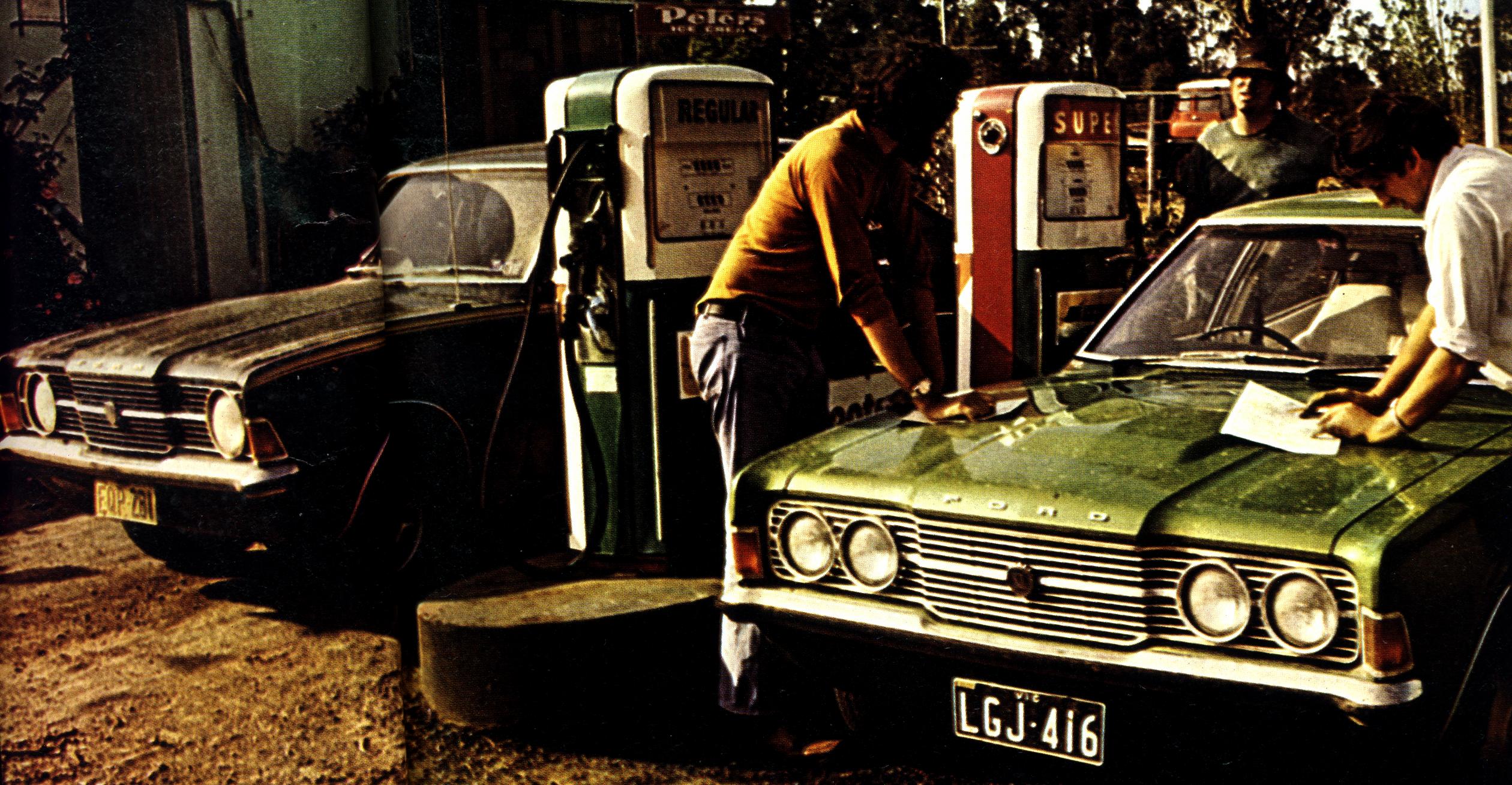
Below: Consumption of Cortina Four and Six was checked three times during 200-plus mile trip that included city, suburbs, expressway, ordinary highway, country roads, and good and bad gravel stretches. The Four was up to three mpg ahead of the Six which was similarly more economical than the Falcon with the same engine and gearbox.
Fuel Consumption
First check – Both Cortina's covered 69 miles, about 20 of which were
logged through the suburbs with the remainder involving medium to fast cruising
on good bitumen mountain roads and some flat country.
Cortina 2000: 2.72gals
25.36mpg
Cortina Six 250: 2.97gals
23.23mpg
Second
check
– On this stretch the Cortina Six covered 109 miles while the 2000 took in a
detour which increased its tally to 126 miles.
Medium cruising speeds on good and poor country roads: some smooth gravel
and some very rough.
Cortina 2000: 5.48gals
22.99mpg
Cortina Six 250: 5.44gals
20.03mpg
Third
Check
– The Cortinas were accompanied by the Falcon on this 52-mile leg which included
some urban conditions and mainly 50 to 55 mph highway cruising.
Cortina 2000: 1.89gals 27.44mpg
Cortina Six 250: 2.00gals 26.00mpg
Falcon 250:
2.10gals 24.76mpg
Article submitted by Matthew Woolard (July 2000)
BuySellCortina 'Uniting the Cortina world'